CIlimate change is creating pressure for different forms of migration. Surprisingly, the EU has no political response to these international migration movements. According to a recent study by Tampere University, the EU’s silence on climate mobility is strategic. Tightening border measures indicate that public attention has shifted toward security concerns.
T
he climate is warming, livelihoods are undergoing profound change, and entire regions risk becoming increasingly challenging for human habitation. Impacts of climate change are global problems which require international responsibility. One consequence of climate change is reflected in people’s need, or even compulsion, to move, while others remain determined to stay in their home areas despite worsening conditions. Migration takes many forms. As living conditions deteriorate and livelihoods become more difficult to sustain, people may move seasonally to another locality or country to live and work. Others relocate from rural areas to cities as their living conditions decline. Among those fleeing sudden crises, some settle and build their lives in a new environment, while others eventually return to help reconstruct their homes.
A large share of climate change-related mobility takes place within national borders. However, some people end up seeking the conditions for a new life abroad. When people leave their home countries, they encounter the borders of foreign states, along with their border and immigration policies.
Climate mobility is a growing global phenomenon that is relatively well understood both in research and in international climate and migration policy. It is therefore surprising that the EU has developed very few policy positions on the issue. In 2020, two major policy initiatives were launched: the EU’s New Pact on Migration and Asylum, commonly referred to simply as “The New Pact,” and the European Green Deal. The latter addresses climate change, while the former focuses on migration to the EU. The New Pact is a substantial package consisting of 14 separate documents in which climate change is mentioned only five times in total, without being identified as a contributing factor to migration. The Green Deal, meanwhile, examines climate change but likewise fails to establish a connection between these two phenomena, despite their interrelated nature. In other words, the EU remains silent on climate mobility towards the EU.
These findings invite a closer look at the New Pact. The policy framework entered into force in Member States in June 2026, meaning that the new policy measures are only now beginning to be implemented in national legislation and migration governance. What does this new policy approach look like in light of climate change? And how does it affect the prospects of the asylum seekers often referred to as climate refugees, for a safe life within the EU? An analysis conducted as part of two research projects funded by the Research Council of Finland, POEMS and HUMANE-CLIMATE, reveals both what the New Pact says and what it leaves unsaid.
By emphasizing the global nature of climate change, the EU effectively sidesteps responsibility at home.
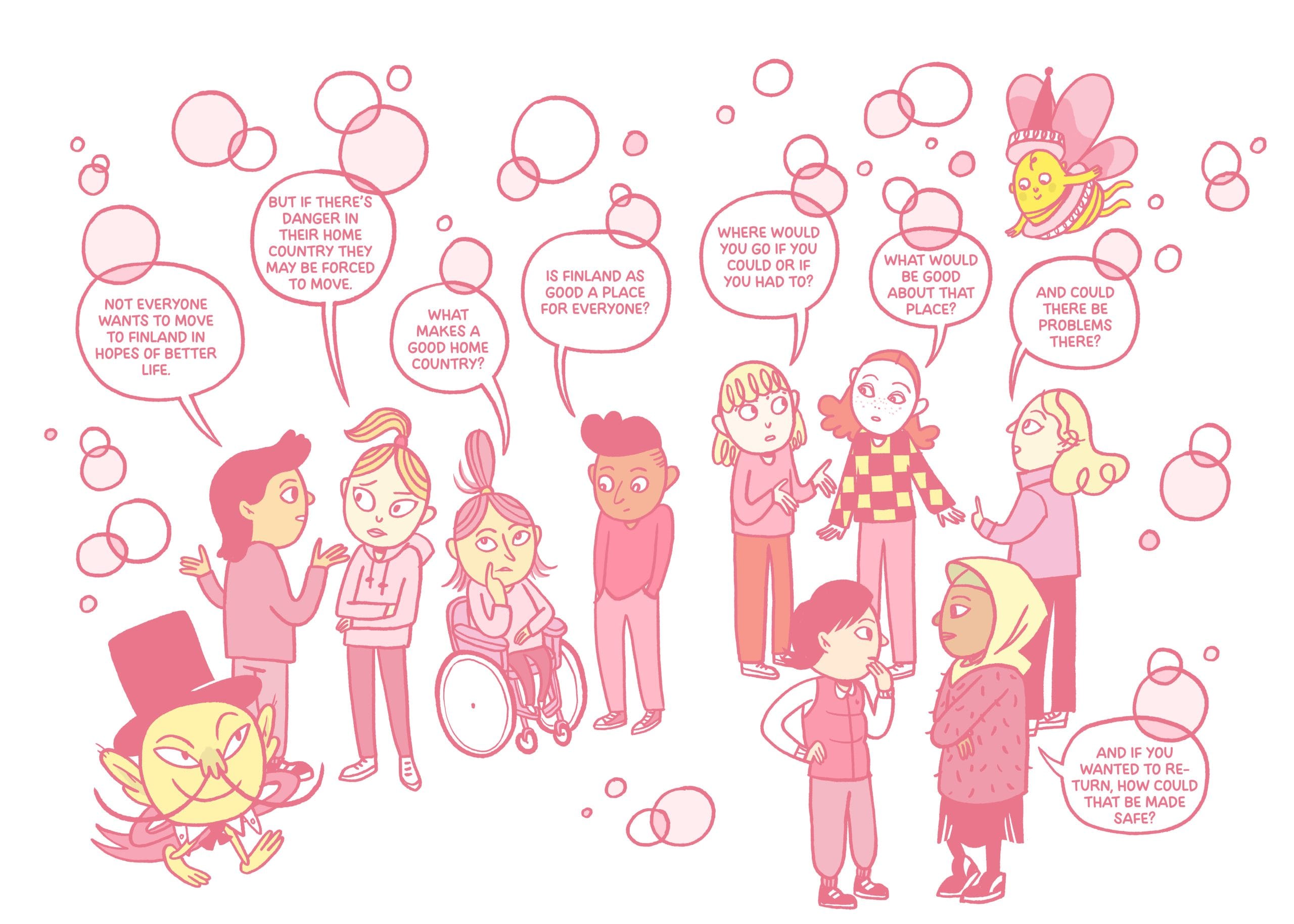
Image: HUMANE-CLIMATE research project
Contradictions Within the New Pact
EU migration and asylum policy is marked by internal tensions. Member States are united in their commitment to upholding international agreements and respecting human rights. Indeed, these principles form the foundation of asylum policy. Disagreements arise, however, over who should bear responsibility in practice and how that responsibility should be shared. At the same time, concerns about national security have become increasingly prominent among both citizens and policymakers. The emphasis on national security is one of the New Pact’s defining underlying themes. As a result, it has evolved into a framework in which human rights and securitization logics alternate, at times uneasily. Humanitarian principles may unexpectedly come to serve as justifications for increasingly restrictive border measures.
One example of the New Pact’s internal tensions concerns its treatment of asylum seekers’ vulnerability, a topic examined by researchers at Tampere University in the POEMS project. The New Pact places greater emphasis on refugees’ vulnerability and specific needs than previous EU policies. A closer look reveals, however, that the rationale is not purely humanitarian. Under the New Pact, vulnerability is not presumed to apply to all asylum seekers, but only to those who meet specific administrative criteria. Is the applicant of a certain age or gender? What is their sexual orientation? Do they have a disability? A large proportion of asylum seekers do not meet these criteria and are therefore not considered vulnerable in the eyes of the authorities. As a result, their entitlement to humanitarian assistance and protection may be limited or denied altogether.
In this framework, life situations rendered untenable by the impacts of climate change, and the resulting vulnerabilities, remain invisible. At the same time, the EU’s way of categorising asylum seekers reduces them to an anonymous mass to be managed through statistical calculations. Rather than being treated as individuals with their own life circumstances and vulnerabilities, they are viewed as units representing particular categories and the likelihoods associated with them. This situation undermines human dignity and agency, further increasing the vulnerability of refugees.
A second example of the New Pact’s internal tensions is its emphasis on “swift and seamless procedures”, meaning accelerated decision-making on whether asylum should be granted or denied. While a swift process is, in itself, desirable from a humanitarian perspective, the other side of the coin is inequality among applicants. Expedited procedures mean easier entry for only a small minority; for most applicants, they amount to a seamless process of removal. The duration of asylum procedures is, in fact, used in various ways as a tool for managing asylum seekers. While some cases are processed as quickly as possible, in other situations applicants are deliberately made to wait longer.
The tension between humanitarian objectives and securitisation creates a self-reinforcing cycle within the New Pact. Framing migration as a security issue has served to justify increasingly restrictive border measures. These measures, in turn, tend to exacerbate the hardships faced by people waiting at the border, thereby creating a greater need for humanitarian assistance. In this way, the EU itself produces vulnerabilities from which it claims to protect asylum seekers.
A Policy Void as a Means of Avoidance
The HUMANE-CLIMATE project’s analysis shows that the EU frames climate mobility primarily as a global issue whose causes and most significant consequences lie beyond its borders. Consequently, the EU focuses on addressing the impacts of climate change in so-called partner countries through a range of cooperation initiatives, with adaptation to climate change serving as the central strategy. These efforts may include local and regional mobility, but never migration towards the EU. EU policy pays little attention to how climate mobility should be addressed within its own Member States. By emphasizing the global nature of the phenomenon, the EU effectively sidesteps responsibility at home. The wicked problem is brushed aside in a philanthropic spirit: it is happening elsewhere, and we are willing to help.
A long-term examination of EU policy reveals that the glaring gap in the EU’s response to climate mobility is not a result of ignorance. On the contrary, climate-driven displacement was already being discussed in EU reports as early as 1999, and the theme has since been addressed in numerous reports produced and commissioned by the EU. Over the past five years, however, the issue has disappeared from all key policy documents. What explains this silence?
The HUMANE-CLIMATE research project identifies this situation as an example of a “policy void”. It refers to a situation in which a recognised phenomenon is framed in such a way that certain dimensions need not be addressed. In other words, the aim is to strategically avoid an issue that is perceived as intractable. The fact that climate mobility is a well-known phenomenon at the EU level, yet there is no intention to develop a political response to migration towards its own territory, means that the EU is actively creating a policy void regarding this issue. The lacking climate mobility policy is thus itself part of the EU’s climate and migration politics.
.
The longer the issue is ignored, the further behind we are falling in responding to it.
The world is becoming increasingly divided between countries and people who are better positioned with regard to climate change and those who have far fewer opportunities to influence and adapt to its impacts. The EU’s new migration and climate policies do not mitigate this divide; rather, they entrench it further. Contrary to the way the EU presents the issue in its policy programmes, climate mobility is not a problem that can be solved locally and thereby removed from the political agenda. As the impacts of climate change continue to intensify, people’s need to move will only increase, forcing the EU to eventually address the issue in its future policy frameworks.
The longer the issue is ignored, the further behind we are falling in responding to it. This is an important consideration in the national implementation of the New Pact. The research recommends that Finnish migration and refugee policy recognize climate change as one of the drivers of forced displacement. Doing so will better equip us to address the real impacts of climate change, which often fall on populations, places, and countries whose contribution to greenhouse gas emissions is marginal both historically and today. Climate change is one of the factors that increases refugees’ vulnerability, and asylum seekers must be able to raise it as part of their claims. It should also be taken seriously when assessing their eligibility for international protection.
KAISLA KAREOJA, JUUSO TARKKA, KIRSI PAULIINA KALLIO
Otsikkokuva: HUMANE-CLIMATE -hanke
Literature
Häkli, J., Kudžmaitė, G., & Kallio, K. P. (2024). Devaluing personhood: The framing of migrants in the EU’s new pact on migration and asylum. Transactions of the Institute of British Geographers, 49(4), e12676. https://doi.org/10.1111/tran.12676
Häkli, J., & Peltonen, N. (2026). The European Union as a humanitarian border: The production of vulnerability in the New Pact on Migration and Asylum. Space and Polity, 30(2), 105–123. https://doi.org/10.1080/13562576.2026.2635505
EU’s politics of void: Avoidance of climate mobility in policy framing. [Forthcoming].
Kaisla Kareoja is the editor-in-chief in Versus. She works as a PhD researcher at Hanken School of Economics on incentives to conserve agrobiodiversity.
Juuso Tarkka is a doctoral researcher at the Tampere University and a class teacher. He worked as a research assistant in the HUMANE-CLIMATE project.
Kirsi Pauliina Kallio is Professor of Environmental Pedagogy and Education at Tampere University. She acted as the leader of the HUMANE-CLIMATE (2022-2026) research project funded by the Research Council of Finland.


CIlimate change is creating pressure for different forms of migration. Surprisingly, the EU has no political response to these international migration movements. According to a recent study by Tampere University, the EU’s silence on climate mobility is strategic. Tightening border measures indicate that public attention has shifted toward security concerns.
T
he climate is warming, livelihoods are undergoing profound change, and entire regions risk becoming increasingly challenging for human habitation. Impacts of climate change are global problems which require international responsibility. One consequence of climate change is reflected in people’s need, or even compulsion, to move, while others remain determined to stay in their home areas despite worsening conditions. Migration takes many forms. As living conditions deteriorate and livelihoods become more difficult to sustain, people may move seasonally to another locality or country to live and work. Others relocate from rural areas to cities as their living conditions decline. Among those fleeing sudden crises, some settle and build their lives in a new environment, while others eventually return to help reconstruct their homes.
A large share of climate change-related mobility takes place within national borders. However, some people end up seeking the conditions for a new life abroad. When people leave their home countries, they encounter the borders of foreign states, along with their border and immigration policies.
Climate mobility is a growing global phenomenon that is relatively well understood both in research and in international climate and migration policy. It is therefore surprising that the EU has developed very few policy positions on the issue. In 2020, two major policy initiatives were launched: the EU’s New Pact on Migration and Asylum, commonly referred to simply as “The New Pact,” and the European Green Deal. The latter addresses climate change, while the former focuses on migration to the EU. The New Pact is a substantial package consisting of 14 separate documents in which climate change is mentioned only five times in total, without being identified as a contributing factor to migration. The Green Deal, meanwhile, examines climate change but likewise fails to establish a connection between these two phenomena, despite their interrelated nature. In other words, the EU remains silent on climate mobility towards the EU.
These findings invite a closer look at the New Pact. The policy framework entered into force in Member States in June 2026, meaning that the new policy measures are only now beginning to be implemented in national legislation and migration governance. What does this new policy approach look like in light of climate change? And how does it affect the prospects of the asylum seekers often referred to as climate refugees, for a safe life within the EU? An analysis conducted as part of two research projects funded by the Research Council of Finland, POEMS and HUMANE-CLIMATE, reveals both what the New Pact says and what it leaves unsaid.
Contradictions Within the New Pact
EU migration and asylum policy is marked by internal tensions. Member States are united in their commitment to upholding international agreements and respecting human rights. Indeed, these principles form the foundation of asylum policy. Disagreements arise, however, over who should bear responsibility in practice and how that responsibility should be shared. At the same time, concerns about national security have become increasingly prominent among both citizens and policymakers. The emphasis on national security is one of the New Pact’s defining underlying themes. As a result, it has evolved into a framework in which human rights and securitization logics alternate, at times uneasily. Humanitarian principles may unexpectedly come to serve as justifications for increasingly restrictive border measures.
One example of the New Pact’s internal tensions concerns its treatment of asylum seekers’ vulnerability, a topic examined by researchers at Tampere University in the POEMS project. The New Pact places greater emphasis on refugees’ vulnerability and specific needs than previous EU policies. A closer look reveals, however, that the rationale is not purely humanitarian. Under the New Pact, vulnerability is not presumed to apply to all asylum seekers, but only to those who meet specific administrative criteria. Is the applicant of a certain age or gender? What is their sexual orientation? Do they have a disability? A large proportion of asylum seekers do not meet these criteria and are therefore not considered vulnerable in the eyes of the authorities. As a result, their entitlement to humanitarian assistance and protection may be limited or denied altogether.
In this framework, life situations rendered untenable by the impacts of climate change, and the resulting vulnerabilities, remain invisible. At the same time, the EU’s way of categorising asylum seekers reduces them to an anonymous mass to be managed through statistical calculations. Rather than being treated as individuals with their own life circumstances and vulnerabilities, they are viewed as units representing particular categories and the likelihoods associated with them. This situation undermines human dignity and agency, further increasing the vulnerability of refugees.
A second example of the New Pact’s internal tensions is its emphasis on “swift and seamless procedures”, meaning accelerated decision-making on whether asylum should be granted or denied. While a swift process is, in itself, desirable from a humanitarian perspective, the other side of the coin is inequality among applicants. Expedited procedures mean easier entry for only a small minority; for most applicants, they amount to a seamless process of removal. The duration of asylum procedures is, in fact, used in various ways as a tool for managing asylum seekers. While some cases are processed as quickly as possible, in other situations applicants are deliberately made to wait longer.
The tension between humanitarian objectives and securitisation creates a self-reinforcing cycle within the New Pact. Framing migration as a security issue has served to justify increasingly restrictive border measures. These measures, in turn, tend to exacerbate the hardships faced by people waiting at the border, thereby creating a greater need for humanitarian assistance. In this way, the EU itself produces vulnerabilities from which it claims to protect asylum seekers.
A Policy Void as a Means of Avoidance
The HUMANE-CLIMATE project’s analysis shows that the EU frames climate mobility primarily as a global issue whose causes and most significant consequences lie beyond its borders. Consequently, the EU focuses on addressing the impacts of climate change in so-called partner countries through a range of cooperation initiatives, with adaptation to climate change serving as the central strategy. These efforts may include local and regional mobility, but never migration towards the EU. EU policy pays little attention to how climate mobility should be addressed within its own Member States. By emphasizing the global nature of the phenomenon, the EU effectively sidesteps responsibility at home. The wicked problem is brushed aside in a philanthropic spirit: it is happening elsewhere, and we are willing to help.
A long-term examination of EU policy reveals that the glaring gap in the EU’s response to climate mobility is not a result of ignorance. On the contrary, climate-driven displacement was already being discussed in EU reports as early as 1999, and the theme has since been addressed in numerous reports produced and commissioned by the EU. Over the past five years, however, the issue has disappeared from all key policy documents. What explains this silence?
The HUMANE-CLIMATE research project identifies this situation as an example of a “policy void”. It refers to a situation in which a recognised phenomenon is framed in such a way that certain dimensions need not be addressed. In other words, the aim is to strategically avoid an issue that is perceived as intractable. The fact that climate mobility is a well-known phenomenon at the EU level, yet there is no intention to develop a political response to migration towards its own territory, means that the EU is actively creating a policy void regarding this issue. The lacking climate mobility policy is thus itself part of the EU’s climate and migration politics. .
The world is becoming increasingly divided between countries and people who are better positioned with regard to climate change and those who have far fewer opportunities to influence and adapt to its impacts. The EU’s new migration and climate policies do not mitigate this divide; rather, they entrench it further. Contrary to the way the EU presents the issue in its policy programmes, climate mobility is not a problem that can be solved locally and thereby removed from the political agenda. As the impacts of climate change continue to intensify, people’s need to move will only increase, forcing the EU to eventually address the issue in its future policy frameworks.
The longer the issue is ignored, the further behind we are falling in responding to it. This is an important consideration in the national implementation of the New Pact. The research recommends that Finnish migration and refugee policy recognize climate change as one of the drivers of forced displacement. Doing so will better equip us to address the real impacts of climate change, which often fall on populations, places, and countries whose contribution to greenhouse gas emissions is marginal both historically and today. Climate change is one of the factors that increases refugees’ vulnerability, and asylum seekers must be able to raise it as part of their claims. It should also be taken seriously when assessing their eligibility for international protection.
KAISLA KAREOJA, JUUSO TARKKA, KIRSI PAULIINA KALLIO
Otsikkokuva: HUMANE-CLIMATE -hanke
Häkli, J., & Peltonen, N. (2026). The European Union as a humanitarian border: The production of vulnerability in the New Pact on Migration and Asylum. Space and Polity, 30(2), 105–123. https://doi.org/10.1080/13562576.2026.2635505
EU’s politics of void: Avoidance of climate mobility in policy framing. [Forthcoming].Kaisla Kareoja is the editor-in-chief in Versus. She works as a PhD researcher at Hanken School of Economics on incentives to conserve agrobiodiversity.
Juuso Tarkka is a doctoral researcher at the Tampere University and a class teacher. He worked as a research assistant in the HUMANE-CLIMATE project.
Kirsi Pauliina Kallio is Professor of Environmental Pedagogy and Education at Tampere University. She acted as the leader of the HUMANE-CLIMATE (2022-2026) research project funded by the Research Council of Finland.
Takaisin ylös ↑